
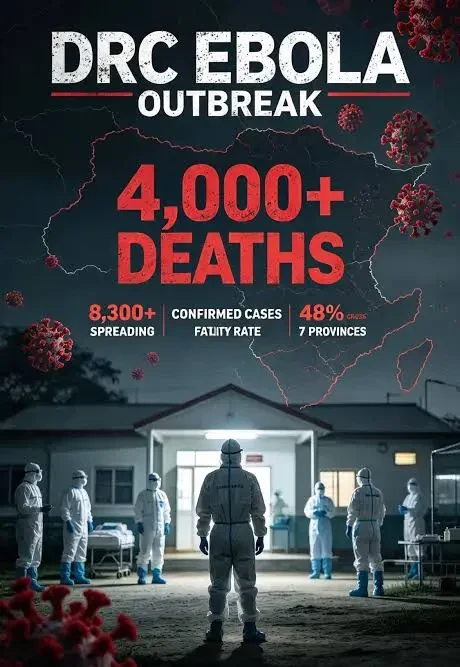
Four thousand and eighteen. That is not a statistic anyone wanted to read on a Friday morning, but it is where the count stood on October 2, 2026, after Congo's government released new figures. Behind the number are 8,300 confirmed cases, seven provinces, and a transit camp that went up in flames while thousands of people slept inside or beside it.
The Ebola outbreak in the Democratic Republic of Congo has killed 4,018 people among 8,300 confirmed cases, according to government data released October 2. It is the deadliest outbreak in the country's history and the second deadliest Ebola epidemic ever recorded, behind West Africa in 2014–2016.
The key figures
Deaths: 4,018
Confirmed cases: 8,300
Case fatality rate: about 48.4 percent
Recovered patients: more than 2,000
Provinces affected: 7 of the country's 26
Declared: May 15, 2026, the DRC's 17th Ebola outbreak
Patients currently in care: 842
Contact tracing rate: about 80.6 percent
Those figures come from the national public health institute and were reported by Reuters and others. The outbreak has now passed the 2018–2020 epidemic in Congo, which had held the grim record until this year.
A different strain
This outbreak is caused by the Bundibugyo species of the Ebola virus, not the Zaire species behind most earlier large outbreaks. That matters because the vaccine most associated with recent Ebola response was built for Zaire. Reporting from the region describes the current strain as a difficult one to protect against with existing tools, which leaves health workers leaning on classic measures: finding cases, isolating patients, tracing contacts, and safe burials.
Why it keeps spreading
Several problems pile up at once. Ituri and North Kivu, where transmission has been heaviest, sit in a region with active conflict, remote roads, and weak health infrastructure. Mistrust of authorities is another factor. Some reports describe community anger over government policies, and a ruling-party member was beaten to death after raising awareness about the outbreak.
Then there is movement. In September, South Ubangi in the northwest became the seventh province to report cases, after a man who had traveled from the east died of Ebola. One infected traveler can carry the virus across the country in days.
The camp fire
The most alarming recent event happened in Ituri. A transit center for Ebola patients was burned down by soldiers, according to reports, and about 19,000 people fled. The camp held roughly 1,000 direct contacts of patients. Authorities have traced only around a fifth of them since the flight. The UN's senior Ebola coordinator, Julien Harneis, warned that losing the facility is a heavy blow to regional capacity.
When contacts scatter into areas outside government control, the chain of tracing breaks. That is exactly how a slowing outbreak can reignite.
Signs of hope
It is not all bad news. More than 2,000 people have recovered. The government and the UN said last month that transmission appeared to be slowing in parts of Ituri. Neighboring Uganda declared its own outbreak over on July 28, and the World Health Organization confirmed that on August 25. Contact tracing at about 80 percent is respectable for the setting.
The World Health Organization still says the epidemic is far from over and could, on current trends, approach the scale of the West African crisis, which infected more than 28,600 people and killed over 11,000.
What can be done
Public health teams generally point to the same list: rebuild the lost transit capacity, restore trust through local leaders and community health workers, protect health staff, and keep roads and borders monitored. Funding gaps are common in outbreaks like this one. Security is the hardest piece, because a health team cannot work where it cannot travel.
How to read the statistics
Case numbers in an outbreak often lag behind reality, especially where testing is limited. The count above is for confirmed cases, so the true size is probably larger. The fatality rate also changes as patients who are still sick either recover or die, so it can move in either direction.
Frequently asked questions
How many people have died in the DRC Ebola outbreak? The government reports 4,018 deaths as of October 2, 2026.
Is this the worst Ebola outbreak ever? It is the worst in Congo's history and the second deadliest worldwide, after 2014–2016 in West Africa.
What strain is it? Bundibugyo ebolavirus, a different species from the Zaire strain that caused the largest earlier outbreaks.
Has it spread outside Congo? Uganda had cases linked to this outbreak but declared its own outbreak over on July 28. The WHO confirmed that in August.
Should travelers worry? Risk to the general public outside affected areas is low, but travelers to eastern Congo should follow health ministry and WHO guidance closely.




Comments
Leave a Comment
Your email address will not be published. Required fields are marked *