
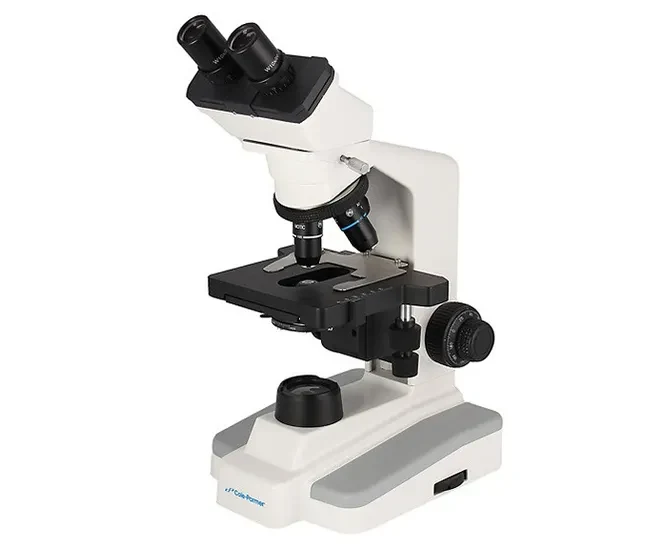
A compound microscope is a powerful tool used to view small objects that are invisible to the naked eye. It uses multiple lenses to magnify tiny specimens, making it invaluable in biology, medicine, and research.
Components of a Compound Microscope
A compound microscope consists of several key components:
- Eyepiece (Ocular Lens) – This is the lens you look through. It typically provides 10x magnification.
- Objective Lenses – These are mounted on a rotating nosepiece. Common magnifications include 4x, 10x, and 40x.
- Stage – The flat platform where you place the slide containing the specimen.
- Stage Clips – These secure the slide in place on the stage.
- Diaphragm – Controls the amount of light passing through the specimen.
- Coarse and Fine Focus Knobs – These adjust the focus of the image. The coarse knob is for large adjustments, while the fine knob sharpens the image.
- Illuminator – Provides light to illuminate the specimen. It can be a mirror or a built-in light source.
- Arm and Base – The arm supports the upper parts, and the base holds everything steady.
How a Compound Microscope Works
A compound microscope operates by utilizing light to enlarge small samples. The light travels through the specimen placed on the slide and enters the objective lens. The objective lens then magnifies the image, which is further magnified by the eyepiece.
Total magnification is calculated by multiplying the magnification of the eyepiece by that of the objective lens. For instance, using a 10x eyepiece in conjunction with a 40x objective lens results in a total magnification of 400x.
Importance of the Compound Microscope
The compound microscope is essential for studying cells, bacteria, tissues, and other microscopic organisms. It revolutionized science by allowing researchers to observe structures that were previously unseen.
In medical labs, it helps in diagnosing diseases by examining blood samples, tissues, or pathogens. In educational settings, it enables students to explore the microscopic world, fostering a deeper understanding of biology.
Advantages
- High Magnification – It can magnify up to 1000x or more, revealing fine details.
- Clear Images – When properly focused, it provides sharp, high-resolution images.
- Versatile – It can use for a wide range of applications, from education to medical research.
Conclusion
The microscope remains an indispensable tool in science. It allows researchers and students to explore and understand the microscopic world. With its multiple lenses and high magnification, it opens up a world of discovery beyond what the naked eye can perceive.