
For the past several years, the global conversation surrounding artificial intelligence has been almost entirely dominated by screens. We interact with advanced AI through chat windows on our mobile phones, voice prompts piped through smart speakers in our kitchens, and generative text algorithms drafting emails on office laptops. Up to this point, artificial intelligence has largely lived as a disembodied digital companion—smart, fast, and conversational, but strictly confined to the virtual realm of software and data centers.
Today, however, that paradigm is shifting with breathtaking speed. The next great frontier of artificial intelligence is no longer hiding behind a glass monitor; it has physical weight, steel limbs, wheels, and articulated hands. We are standing on the precipice of a massive industrial and domestic transition, moving away from purely digital assistants and stepping firmly into the era of physical AI and embodied robotics.
The Convergence of Large Language Models and Robotics
To understand why this seismic shift is happening right now, one must examine how artificial intelligence and machine learning have evolved over the past decade. Until recently, training a robot to perform even simple physical tasks required meticulous, hard-coded programming for every single movement. If a robotic manufacturing arm needed to grasp a fragile glass object or lift an irregular component, engineers had to manually program exact coordinate grids, precise grip pressures, and complex spatial calculations. This made traditional industrial robots incredibly rigid, expensive, and useful only in highly controlled environments like hyper-automated automotive assembly lines.
The true game-changer is the recent convergence of advanced generative AI models with high-performance robotics hardware. Technology companies are now taking the foundational intelligence of Large Language Models (LLMs)—their deep ability to understand natural human language, reason through multi-step logical problems, and adapt dynamically to new context—and embedding them directly into physical machinery.
Instead of writing thousands of lines of complex custom code, software developers and operators can now use everyday natural language to command a robot. A factory worker can simply say, "Pick up the red mounting bracket from the conveyor belt and place it gently into the assembly bin," and the robot’s onboard multimodal AI interprets the command, maps its physical environment using spatial computing, calculates the physics of the object, and executes the task autonomously.
Transforming the Factory Floor and Global Supply Chains
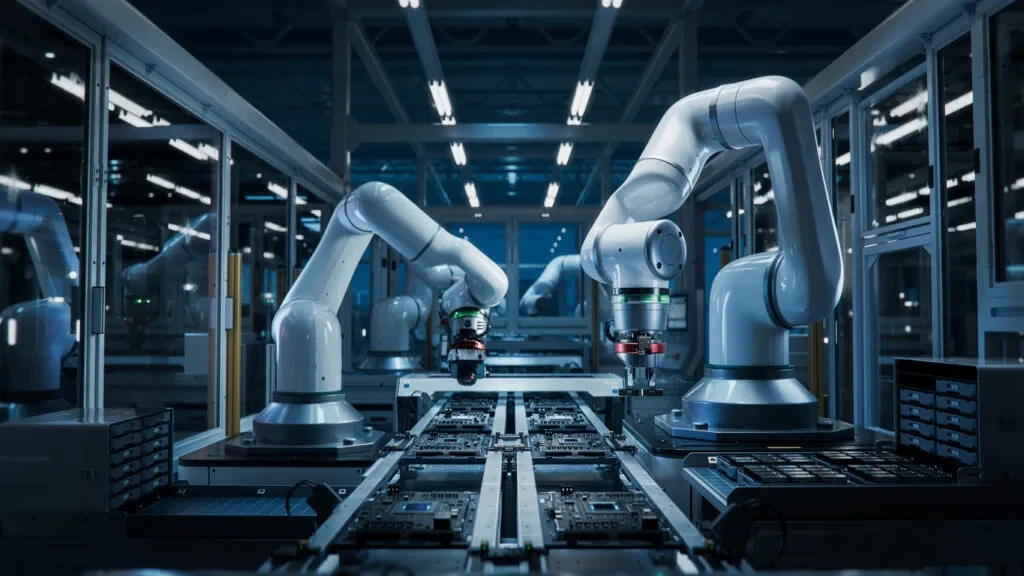
The most immediate, economically profound impact of this transition is currently unfolding within heavy industrial manufacturing, warehousing, and global logistics networks. Traditional industrial robots were historically caged off completely from human workers behind safety barriers, programmed to repeat one specific, mindless motion millions of times without deviation.
Embodied AI changes the factory floor entirely. Modern industrial robots equipped with advanced computer vision, depth sensors, and tactile feedback can work safely side-by-side with human operators in dynamic, unpredictable environments.
Adaptive Assembly: If an incoming manufacturing part arrives slightly out of alignment or warped, the robot does not crash, jam, or stall; its onboard AI instantly adjusts its grip orientation and force in real time.
Autonomous Warehousing and Fulfillment: Next-generation distribution centers utilize autonomous mobile robots that can navigate crowded aisles, reason through inventory bottlenecks, and handle irregular consumer items with human-like dexterity.
Predictive Mechanical Maintenance: Physical AI systems monitor their own mechanical wear-and-tear continuously, analyzing microscopic vibrations, thermal output, and power draws to predict component failures long before they can halt production lines.
This monumental shift transforms robots from specialized, single-purpose tools into flexible, intelligent workforce partners capable of alleviating acute labor shortages across global supply chains.
Beyond the Factory: Humanoids and Domestic Automation
While controlled industrial settings represent the immediate commercial boom, the long-term vision of physical AI extends directly into everyday life, homes, and public spaces. Across technology research hubs worldwide, major companies are pouring billions of dollars into developing general-purpose humanoid robots designed specifically to navigate human-centric environments.
Because our physical world is built exclusively for humans—featuring standard staircases, traditional door handles, standard kitchen counters, and tools designed for two hands—bipedal and wheeled humanoid robots represent the ultimate form factor for universal automation. In the coming years, we are likely to see these robotic systems transition gradually from controlled testing laboratories into commercial retail spaces, eldercare facilities, and eventually residential households.
Imagine an advanced robotic assistant capable of doing laundry, unloading groceries, helping elderly family members move safely around the house, or performing hazardous maintenance work like inspecting roof damage or repairing electrical grids. By bridging the gap between digital reasoning and physical execution, artificial intelligence is preparing to step off the glowing screen and directly into our physical reality.
Frequently Asked Questions (FAQ)
1. What is the difference between traditional industrial robots and AI-driven physical robots?
Traditional robots are bound by rigid, hard-coded instructions and require tightly controlled environments to perform repetitive tasks. AI-driven physical robots utilize machine learning, advanced computer vision, and neural language models to perceive their environment, reason through unexpected changes, and adapt their physical actions autonomously.
2. Why are humanoid robots becoming popular in AI development?
Humanoid robots are designed with a form factor tailored for a world built by humans. Because they possess legs, arms, and articulating hands similar to our own, they can navigate standard staircases, open traditional doors, and utilize tools built for human hands without requiring expensive infrastructure redesigns.
3. How do Large Language Models (LLMs) help physical robots function?
Large Language Models allow humans to communicate directly with robots using everyday natural language rather than complex programming code. The AI translates human intent into actionable physical tasks by breaking down complex requests into logical, sequential steps.
4. Will physical AI replace human workers entirely?
Rather than total workforce replacement, physical AI is designed to augment human labor. It takes over dangerous, physically exhausting, and highly repetitive tasks while allowing human workers to focus on supervision, creative problem-solving, quality assurance, and strategic management.






Comments
Leave a Comment
Your email address will not be published. Required fields are marked *