
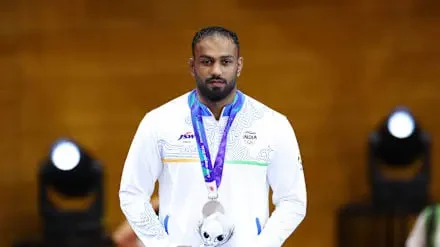
Losing a final is rarely something a country celebrates. On Thursday in Nagoya, India did, because the man who lost it had just ended a wait that began when Jawaharlal Nehru was still prime minister.
Short answer: Nitesh Siwach, 23, won silver in the men's Greco-Roman 97kg at the 2026 Asian Games after a 4-0 loss to Japan's Yuri Nakazato in the final. It is India's first Asian Games Greco-Roman silver in 64 years, and he is the first Indian to fight for a Greco-Roman gold medal at the Games in a standalone final.
The final
The bout took place at the Nagoya City Inae Sports Center. Nakazato, wrestling at home, scored four unanswered points and kept Siwach from finding a way back. There was no controversy, and no late drama. The Japanese wrestler was simply a notch better on the day.
That should not erase what Siwach did to get there. He had a direct entry into the quarterfinals and opened with a 7-1 win over Amanberdi Agamammedov of Turkmenistan. He then won through to the final, where only gold stood between him and a place in the record books.
Why 64 years matters
Greco-Roman wrestling made its Asian Games debut in Jakarta in 1962, and India did well. Udey Chand (70kg), Sajjan Singh (87kg), and Maruti Mane (97kg) all won silver. Mane, notably, competed in the same weight class Siwach just medaled in. After that, no Indian Greco-Roman wrestler stood on an Asian Games podium with a silver for six decades.
Indian wrestling has long been dominated by freestyle, where the legs can be attacked and where stars like Yogeshwar Dutt and Sushil Kumar made their names. Greco-Roman is stricter. Holds below the waist are banned, so it favors upper-body strength, throws, and technique. The country has produced fewer champions there, which is why this silver feels bigger than the color suggests.
Who is Nitesh Siwach?
He is 23 and had a quiet build-up to this event. He won silver at the 2026 Asian Wrestling Championships earlier this year, which earned him the direct quarterfinal entry in Nagoya. National coach Hargobind Singh was beside him as he posed with the medal.
He is also only the second Indian Greco-Roman wrestler to reach an Asian Games final, which gives some context for how rare this is.
The rest of India's day
Not everything went India's way on Thursday. Mansi Ahlawat lost her bronze medal match in the women's 62kg and missed the podium. Wrestling at this level is unforgiving: one slipped hold in the final seconds can decide whether you go home with a medal or without one.
What it could mean for Indian wrestling
A podium finish tends to change things. It can bring funding, coaching, and attention to a discipline that has sat in freestyle's shadow. Young wrestlers in akharas across Haryana and elsewhere now have a concrete example. For the federation, the result is also a reminder to invest in Greco-Roman pathways rather than treating them as an afterthought.
The bigger test comes next. Siwach is young, and a major world championship or the next Olympic cycle is the real measure. Silver at the Asian Games shows he belongs in the conversation. Gold somewhere else would prove it.
Key facts at a glance
Event: Men's Greco-Roman 97kg, Asian Games 2026
Venue: Nagoya City Inae Sports Center, Nagoya, Japan
Final result: Yuri Nakazato (Japan) beat Nitesh Siwach (India) 4-0
Medal: Silver
Historic significance: First Indian Greco-Roman Asian Games silver since 1962
Frequently asked questions
Did Nitesh Siwach win a medal at the Asian Games 2026? Yes, a silver in the men's Greco-Roman 97kg.
Who beat him in the final? Yuri Nakazato of Japan, by 4-0.
Why is this medal historic? It is India's first Asian Games silver in Greco-Roman wrestling in 64 years, since the style debuted at Jakarta 1962.
What is Greco-Roman wrestling? A style in which wrestlers can only grab and attack above the waist, so it relies on upper-body throws and holds.
How old is Nitesh Siwach? He is 23.





Comments
Leave a Comment
Your email address will not be published. Required fields are marked *