
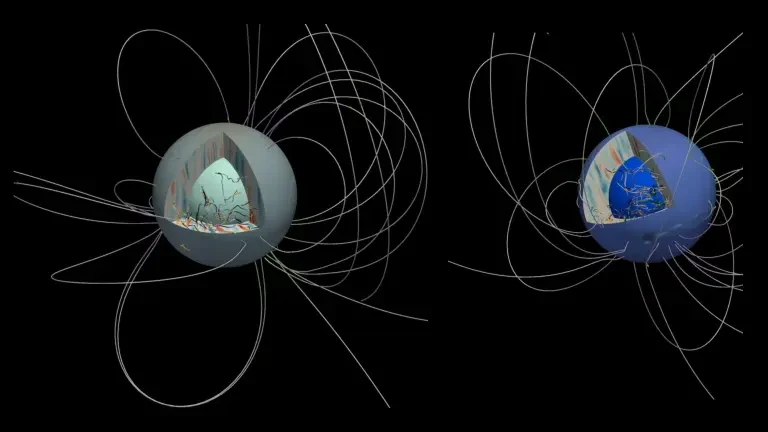
For nearly forty years, the strange and erratic nature of the magnetic fields belonging to Uranus and Neptune has remained one of the most perplexing puzzles in planetary science. When NASA’s Voyager 2 spacecraft flew past Uranus in 1986, it transmitted data revealing a magnetic environment unlike anything else observed in our solar system.
Unlike Earth, Jupiter, or Saturn—whose magnetic fields closely align with their rotational axes and behave in predictable, symmetric ways—the magnetic field of Uranus is heavily tilted, severely offset from the planet's core, and remarkably asymmetric. For decades, researchers struggled to reconcile these bizarre characteristics with standard planetary dynamo models. However, recent advances in planetary modeling and fresh re-examinations of historical data are finally shedding light on why the ice giants behave so differently.
The Enigma of the Ice Giants' Magnetosphere
To understand why Uranus perplexed astronomers, it helps to look at how planetary magnetic fields are normally generated. Inside planets like Earth, the churning motion of electrically conducting fluids deep within the core creates a dynamo effect, generating a powerful magnetic field that typically aligns closely with the planet's spin axis.
On Uranus, the situation is drastically different. The planet's magnetic dipole is tilted at a staggering angle of nearly 60 degrees relative to its rotational axis, and its magnetic center is heavily offset from the geometric center of the planet. Furthermore, Voyager 2's historical flyby depicted a magnetosphere that appeared compressed, warped, and unusually devoid of standard plasma and heavy ions. For generations, scientists debated whether this chaotic setup was a permanent structural feature or the result of unusual external conditions.
Breakthroughs in Interior Modeling
Recent scientific simulations focusing on the high-pressure, high-temperature environments deep inside the ice giants have provided critical clues. Unlike gas giants like Jupiter and Saturn—which are composed predominantly of hydrogen and helium—Uranus and Neptune contain vast quantities of heavier fluid compositions, including water, ammonia, and methane, often referred to in planetary science as "ices".
Deep inside these planets, extreme pressures and temperatures create unique fluid dynamics where electrically conducting layers behave unpredictably. Advanced computer models demonstrate that the convection currents driving the dynamo inside Uranus are not neatly layered or symmetrical like Earth's core flows. Instead, complex fluid motions occur across disjointed depth zones, producing unstable, multi-pole magnetic fields that can shift and tilt dramatically over relatively short geological timescales.
Revisiting the Voyager 2 Encounter
Compounding the theoretical breakthroughs, modern re-analyses of the 1986 Voyager 2 data have offered a fresh perspective. Researchers examining the days leading up to and following the historic flyby discovered that Uranus happened to experience an intense solar wind compression event precisely when the spacecraft arrived.
The solar storm effectively battered and compacted the planet's magnetosphere, presenting a skewed snapshot that was drastically different from the planet's average baseline state. Scientists now understand that Voyager 2 captured Uranus during an atypical window—accounting for only a tiny fraction of normal conditions—which exaggerated the apparent chaos of its magnetic environment.
Frequently Asked Questions (FAQ)
What makes the magnetic field of Uranus so unusual?
Unlike Earth or Jupiter, where the magnetic field aligns closely with the rotational axis, the magnetic field of Uranus is tilted by nearly 60 degrees and heavily offset from the planet's geometric center.
Why did Voyager 2's data confuse scientists for decades?
Voyager 2 flew past Uranus during a rare, intense solar storm that compressed and distorted the planet's magnetosphere, making its normal baseline behavior appear far more chaotic than it typically is.
How are planetary magnetic fields generated?
Planetary magnetic fields are typically generated by a "dynamo effect," where the swirling, convective movement of electrically conducting liquid deep inside a rotating planet produces a powerful magnetic field.
Why are Uranus and Neptune classified as "ice giants"?
While gas giants like Jupiter and Saturn are mostly hydrogen and helium, Uranus and Neptune contain much higher concentrations of heavier fluids like water, ammonia, and methane, which scientists collectively term planetary "ices".
Conclusion
The decades-long mystery surrounding Uranus's erratic magnetic field is finally finding resolution through a combination of cutting-edge computer simulations and careful re-evaluations of vintage space probe data. By understanding how extreme interior fluid dynamics interact with intense solar weather, scientists are gaining a clearer picture of the physics governing ice giants. As space agencies look toward future dedicated missions to the outer solar system, decoding the secrets of Uranus will continue to unlock broader insights into planetary formation and evolution across the cosmos.

Comments
Leave a Comment
Your email address will not be published. Required fields are marked *