
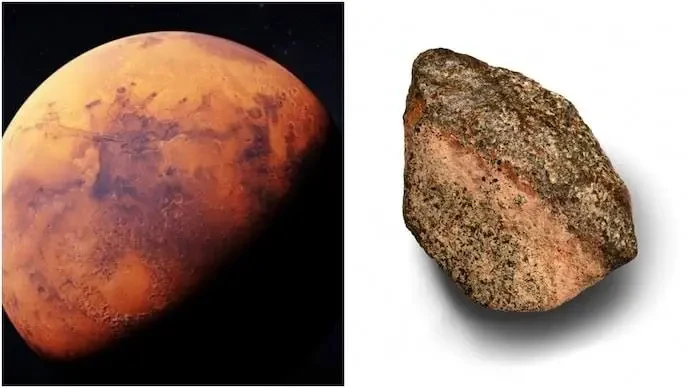
The exploration of the Red Planet has reached a fascinating and unexpected milestone. Space science has long relied on Martian meteorites—rocks blasted off the surface of Mars by ancient asteroid impacts that eventually crash-land on Earth—to decode the geological history of our neighboring world. However, a groundbreaking discovery hidden inside a rare space rock has left researchers stunned and eager to rewrite planetary textbooks. By analyzing a fragment of a Martian meteorite, an international team of geologists and planetary scientists has identified a completely new type of rock and detected the mineral garnet on Mars for the very first time.
This monumental finding opens a fresh window into the planet's infancy, shedding brilliant light on ancient magmatic processes that happened billions of years ago and changing how we view planetary evolution across the solar system.
Unlocking the Mystery of Martian Meteorite NWA 8171
Most meteorites originating from Mars fall into well-documented and familiar categories, such as shergottites, nakhlites, or chassignites, which are typically composed of volcanic materials like basalt and olivine. These samples have provided decades of invaluable data about surface and near-surface conditions on Mars. However, exceptional specimens occasionally surface in meteorite collections, challenging established geological models and pushing analytical science to its absolute limits.
When researchers closely examined fragments of a specific Martian meteorite using advanced electron microscopy, high-resolution spectroscopy, and specialized laser equipment, they stumbled upon mineral formations that did not match any previously cataloged Martian sample. The most striking and revolutionary surprise was the undeniable presence of garnet—a complex silicate mineral that forms only under extreme, high-pressure and high-temperature conditions deep within a planet's crust or mantle.
Because garnet acts as a geological time capsule, its discovery inside a Martian matrix provides unprecedented physical data about the deep interior dynamics and tectonic history of early Mars.
What the New Rock Type Reveals About Ancient Mars
The identification of this unique rock type and its rare mineral components offers critical answers regarding how Mars evolved over its 4.5-billion-year history. Understanding what was happening deep beneath the Martian surface during its formative years helps scientists solve several long-standing planetary puzzles:
Clues to Deep Crustal and Mantle Processes: Garnet requires immense pressure to crystallize. Finding it indicates that early Mars experienced intense internal pressures, deep magmatic fractionation, or complex crustal cycling processes that were previously thought to be absent or minimal on the Red Planet.
A Window Into Ancient Hydrothermal and Thermal Environments: The chemical makeup trapped within these unique crystal structures preserves pristine signatures of temperatures, pressures, and fluid movements from billions of years ago, unaffected by millions of years of surface weathering.
Reconstructing Planetary Evolution and Heat Loss: By understanding the precise conditions required to create this specific rock type, planetary geologists can better map out how Mars cooled over time, transitioned from a warm, dynamic world into a cold, arid desert, and lost its global magnetic field.
Coupled with other ancient Martian samples—such as ancient rocks revealing past water reservoirs, crustal interactions, and volcanic activity—this new rock type reinforces the view that early Mars possessed a deeply complex, active interior rather than being a simple, uniform volcanic world.
The Technological Leap Behind the Discovery
Finding microscopic signatures of a new rock type within a rare meteorite is no small feat. It requires state-of-the-art laboratory technology capable of peering deep into the atomic structure of rocks without destroying the precious samples.
Scientists utilized high-precision mass spectrometry and electron backscatter diffraction to map out the crystal lattices of the meteorite grains. These advanced methods allow researchers to distinguish between minerals formed on Earth through terrestrial contamination and those forged under true extraterrestrial conditions. Because Martian meteorites often sit in deserts or ice fields for thousands of years before being recovered by meteorite hunters, proving the indigenous Martian origin of such delicate minerals is a major triumph of modern analytical science. This technological precision ensures that every conclusion drawn about the Martian interior is rock-solid and verified.
Frequently Asked Questions (FAQ)
1. What makes the discovery in the Martian meteorite so unusual?
Scientists discovered a completely new type of rock and found garnet for the very first time in a Martian sample, a mineral that requires intense pressure and extreme temperatures to form deep underground.
2. How do scientists know the meteorite actually came from Mars?
Researchers confirm the planetary origin of these rocks by analyzing trapped gases and oxygen isotopes, which act as unique chemical fingerprints matching atmospheric data gathered directly by spacecraft and rovers operating on Mars.
3. Why is finding garnet on Mars so significant for space science?
Garnet acts as a geological time capsule. It preserves physical records of the deep temperatures, pressures, and dynamic tectonic or magmatic processes that shaped the Martian interior billions of years ago.
4. How do researchers study these tiny meteorite fragments without destroying them?
Scientists use advanced, non-destructive high-precision tools such as specialized laser equipment, electron microscopy, and in-situ micro-analysis that require only microscopic samples, keeping the bulk of the rare meteorite intact for future generations of research.
Looking Forward: The Future of Martian Geology
As laboratory techniques continue to advance and future sample-return missions bring pristine Martian regolith back to Earth directly from Jezero Crater, discoveries like this new rock type are only the beginning. Each meteorite and returned sample acts as a crucial piece of a massive cosmic puzzle. By piecing together the deep interior secrets of Mars, scientists are not only learning about our neighboring planet's dramatic past, but also gaining vital context about how rocky planets—including our own Earth—form, evolve, and sustain or lose their planetary habitability over billions of years.
Comments
Leave a Comment
Your email address will not be published. Required fields are marked *