
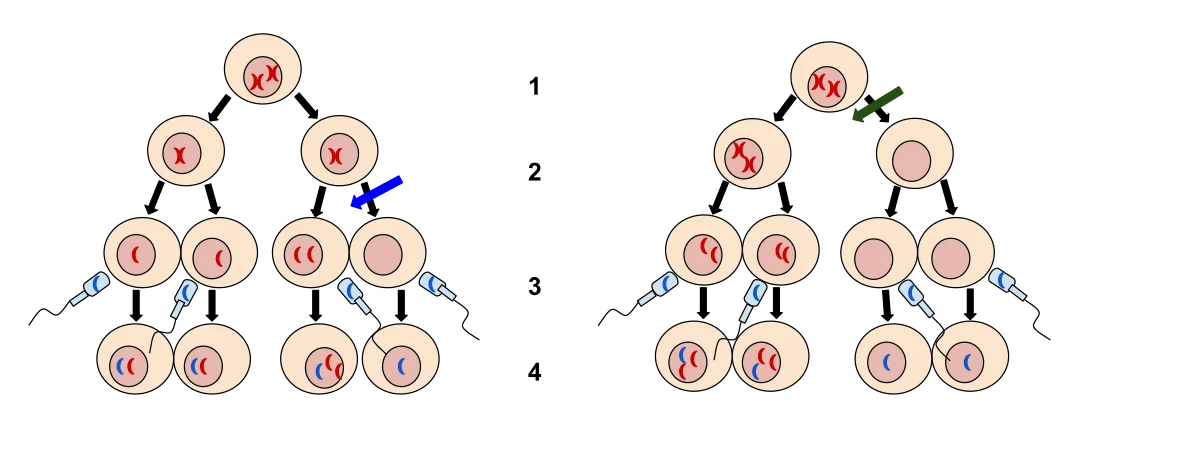
Meiosis is the specialized form of cell division that produces eggs and sperm. In humans, it normally reduces the chromosome number from 46 to 23 so that fertilization can restore the usual total of 46 chromosomes.
What can go wrong during meiosis?
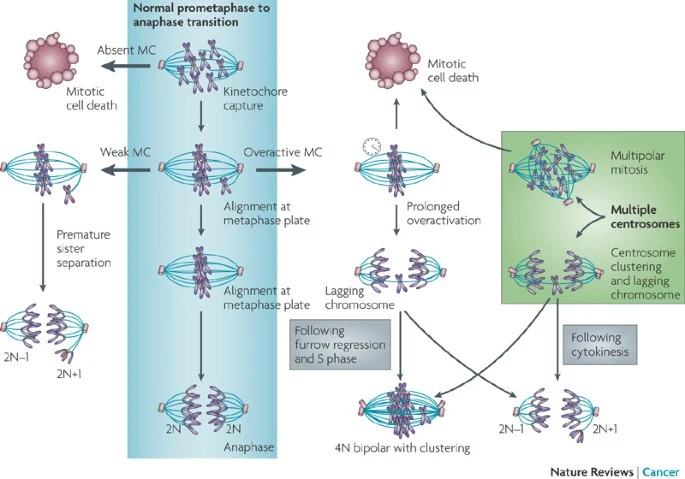
Chromosomes must separate accurately as cells progress through meiosis. If they fail to separate normally, an egg or sperm can receive an extra chromosome or lack one. This type of separation error is called nondisjunction.
After fertilization, such an error can result in aneuploidy, meaning that cells contain an abnormal number of chromosomes. Examples include trisomy 21, which causes Down syndrome, monosomy X associated with Turner syndrome, and XXY associated with Klinefelter syndrome.
Chromosomal rearrangements
Chromosome structure can also be altered through events such as deletions, duplications, inversions and translocations. These are different from simply having an extra or missing chromosome. Their effects vary according to the chromosomes and genetic material involved.
Some people carry a balanced chromosomal rearrangement without obvious health effects but can have an increased risk of infertility, miscarriage or a pregnancy affected by an unbalanced chromosome complement.
What is not a meiotic chromosome-number disorder?
It is important to distinguish chromosomal abnormalities from single-gene disorders. Cystic fibrosis and sickle cell disease are inherited single-gene conditions; they are not caused by an extra or missing chromosome produced by meiotic nondisjunction.
Age and chromosome risk
The likelihood of some chromosome-number abnormalities increases with maternal age. However, meiotic errors can occur at different reproductive ages, and an individual pregnancy cannot be assessed from age alone.
Testing and genetic counseling
Screening tests can estimate the chance of certain chromosome conditions during pregnancy, while diagnostic tests such as chorionic villus sampling and amniocentesis can provide more definitive chromosome information. These procedures have different purposes and risks and should be discussed with a qualified healthcare professional.
For people experiencing infertility, recurrent pregnancy loss or a known family chromosome rearrangement, a clinician or genetic counselor can advise whether chromosome testing or other genetic evaluation is appropriate.

Comments
Leave a Comment
Your email address will not be published. Required fields are marked *