Learn how Earth’s shadow, atmospheric filtering, and viewing geometry produce the changing appearance of a lunar eclipse.
Earth moves between the Sun and Moon
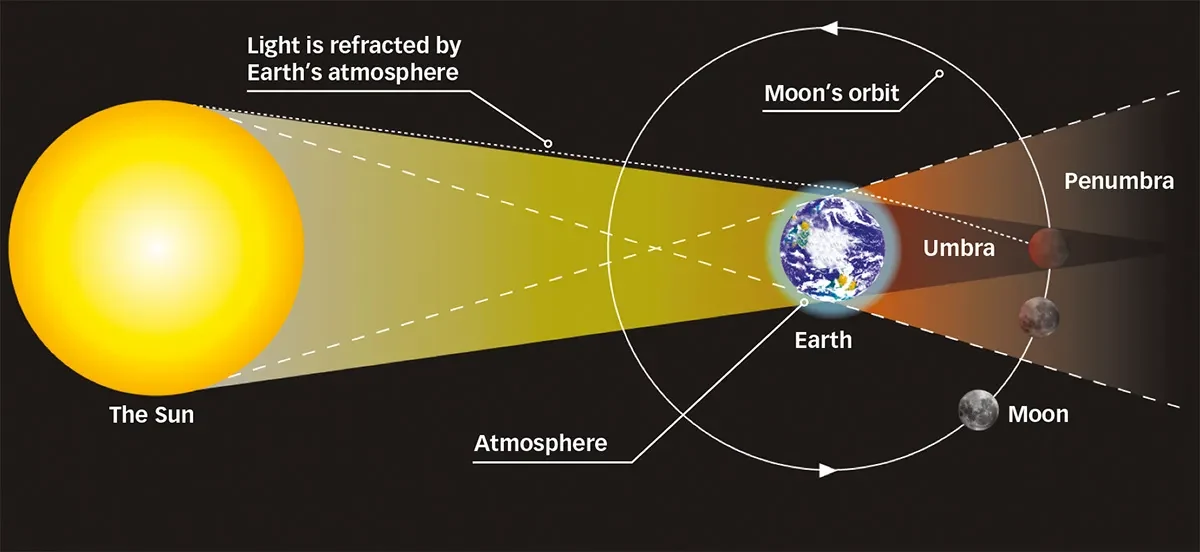
A lunar eclipse occurs when the full Moon moves through Earth’s shadow. Unlike a solar eclipse, the alignment places Earth in the middle, so the event can be visible across much of the night side of the planet when skies are clear.
The shadow has different regions
Earth’s outer shadow is called the penumbra, where sunlight is only partly blocked. The darker central shadow is the umbra. The Moon can pass through one or both regions, producing penumbral, partial, or total lunar eclipses.
Atmospheric light reaches the shadow
During totality, some sunlight passes through Earth’s atmosphere and is bent toward the Moon. Shorter wavelengths are scattered more strongly, while more reddish light can continue through the atmosphere and illuminate the lunar surface.
Color is not identical every time
The Moon may appear copper, orange, deep red, or relatively dark. Clouds, dust, and other conditions in Earth’s atmosphere influence the light that reaches it, while local weather affects what an observer can see.
Observation can remain simple
A lunar eclipse can be watched with the unaided eye when local conditions permit. Binoculars or a camera can reveal more detail, but a clear horizon, current timing information, and patience are the main requirements.