Understand how partial, annular, and total solar eclipses differ, why the view changes by location, and why safe viewing guidance matters.
The alignment creates the event
A solar eclipse occurs when the Moon passes between Earth and the Sun from the viewpoint of part of Earth. The event is not seen in the same way everywhere because the Moon’s shadow covers a limited area and observers stand at different positions within or outside it.
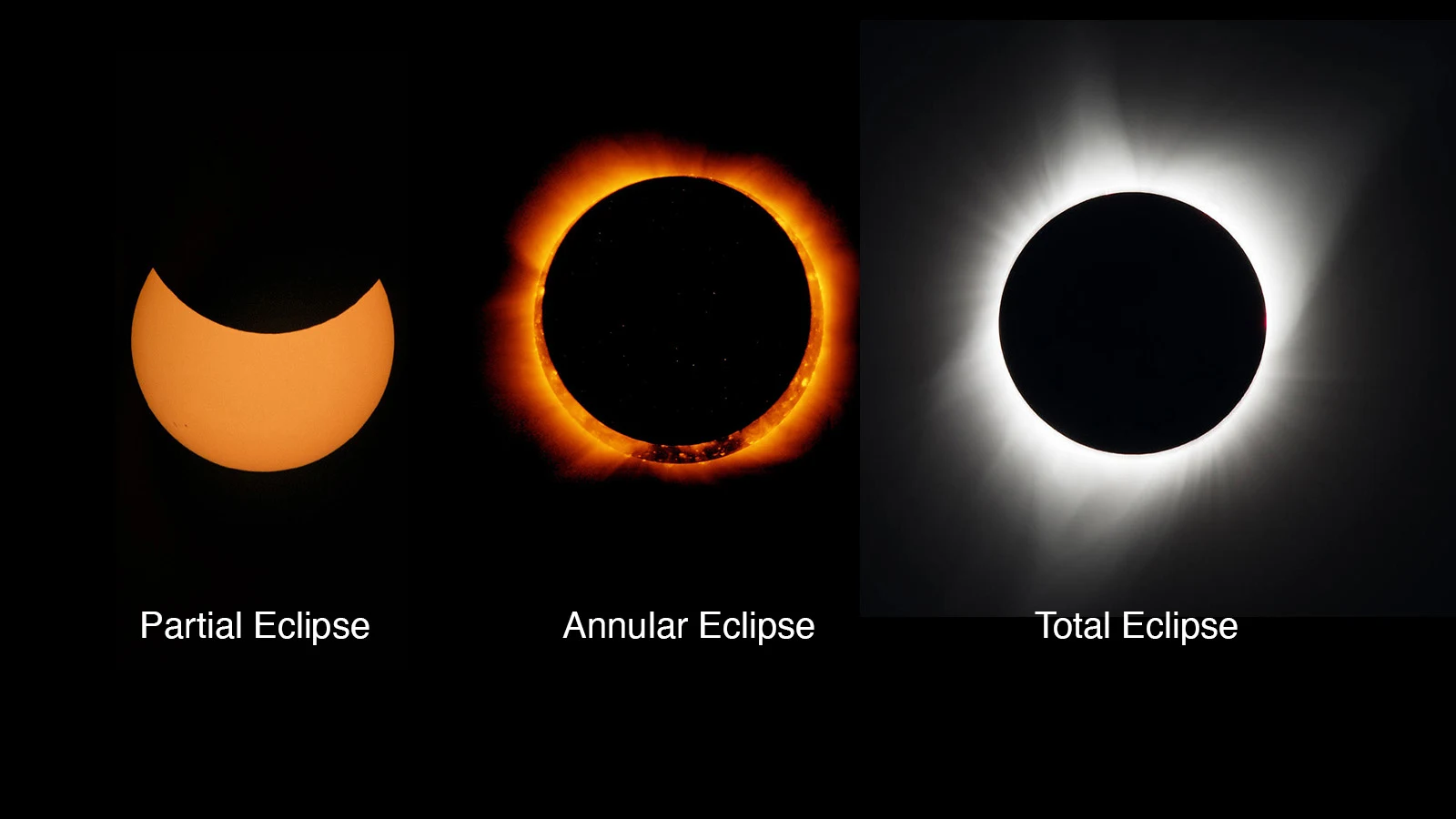
A partial eclipse covers part of the Sun
During a partial eclipse, the Moon appears to obscure only a portion of the solar disc. Partial phases also occur before and after annular or total phases for observers in the relevant viewing region.
An annular eclipse leaves a bright ring
The apparent size of the Moon varies with its distance from Earth. When it looks slightly smaller than the Sun during a central alignment, a bright ring remains visible around it. This is called an annular eclipse.
A total eclipse briefly covers the bright disc
Within the narrow path of totality, the Moon can fully cover the Sun’s bright visible surface for a short period. Outside that path, observers may see only a partial eclipse even when totality occurs elsewhere.
Viewing requires purpose-made protection
Looking at the Sun can injure the eyes. Observers should follow current guidance from recognized astronomy or public-safety authorities and use approved solar-viewing methods for the relevant phase. Ordinary sunglasses are not a substitute.