
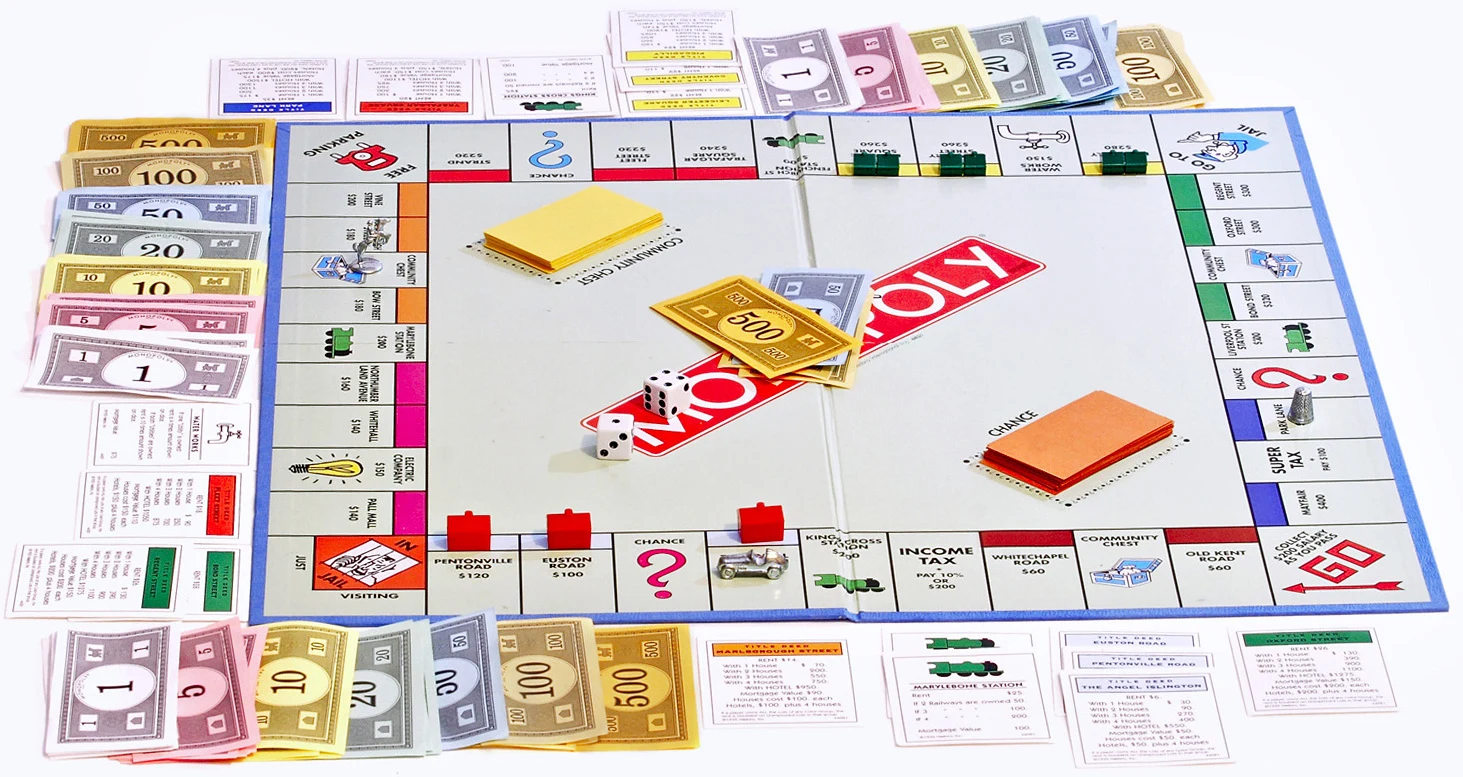
Monopoly is a board game in which players move around a square track, buy property, collect rent and try to bankrupt their opponents. It is one of the best-known board games in the world and has been published in many national and themed editions.
History: from The Landlord's Game to Monopoly
The game's roots go back to Lizzie J. Magie, who filed a patent application on 23 March 1903 for a game board she called "The Landlord's Game" and was granted U.S. Patent 748,626 on 5 January 1904. Magie designed it to illustrate the economic ideas of Henry George, showing how land ownership could concentrate wealth. Versions of the game spread informally over the following decades.
Charles B. Darrow filed an application for a "board game apparatus" on 31 August 1935 and was granted U.S. Patent 2,026,082 on 31 December 1935; the patent was assigned to Parker Brothers, which published Monopoly and also bought Magie's patent.
What is in the box
A standard set includes the board, two dice, player tokens, play money, title deed cards for each property, houses and hotels, and Chance and Community Chest cards.
How the game works
Players take turns rolling the dice and moving their token. Landing on an unowned property gives the option to buy it; landing on someone else's property means paying rent. Owning every property in a colour group lets a player build houses and then hotels, which sharply increases rent. Other spaces include taxes, Chance and Community Chest, Jail and Free Parking. The last player who is not bankrupt wins.
Popular strategies
Many players favour the orange and red groups because they sit a short distance after Jail and are landed on often, and building three houses on a group is a common target. These are widely shared player heuristics rather than guaranteed rules; trading, timing and cash management matter just as much.
Editions, variants and house rules
Licensed editions replace the street names with cities, films or brands. Many households also use house rules, such as placing tax money on Free Parking, which are not in the official rules and tend to make games longer.
Why Monopoly still matters
Monopoly is a staple of family game nights and appears often in films and television. It also has an ironic legacy: a game first designed to criticise land monopolies became famous for celebrating them.
Sources: U.S. Patent 748,626, L. J. Magie, Game-board (1904); U.S. Patent 2,026,082, C. B. Darrow, Board game apparatus (1935).


Comments
Leave a Comment
Your email address will not be published. Required fields are marked *