
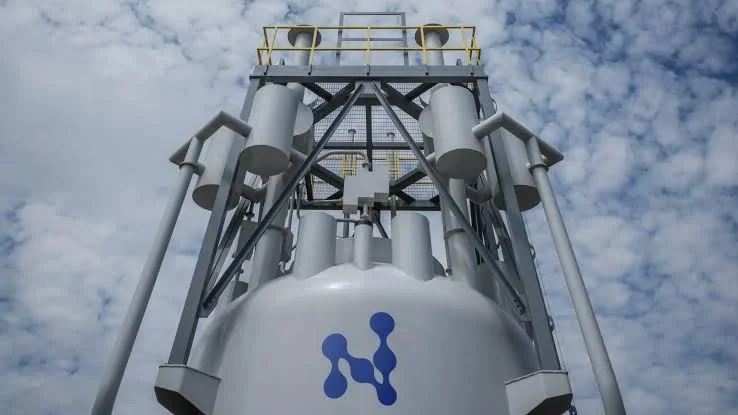
Valar Atomics has proposed "Project Beehive," a complex of about 456 small nuclear reactors and data centers on more than 9,000 acres of federal land near Price, Utah. Together the reactors would produce roughly 9.6 gigawatts of electricity. It's a proposal filed with federal regulators, not a finished or approved project.
What is Project Beehive?
Documents reviewed by NPR show that Valar Atomics, a nuclear startup, has pitched a giant campus on Bureau of Land Management land near Price, Utah. Depending on the report, the footprint is described as over 9,000 or more than 9,500 acres.
The plan bundles several things together: data centers, around 456 small reactors, a facility to make nuclear fuel, and sites to store nuclear waste. The reactors would supply an estimated 9.6 gigawatts of power to the data centers, plus additional heat that could be used for other industrial processes.
How big is 9.6 gigawatts?
Very big. A typical large nuclear plant produces around one gigawatt. So Beehive's output would be equal to roughly nine or ten of them. NPR noted that those traditional reactors are far larger than the small modular reactors Valar plans to use, and that each large reactor can cost many billions of dollars to build.
The scale is also why AI companies are interested. Training and running advanced AI systems takes staggering amounts of electricity, and data center developers have been hunting for power sources that are steady, high-volume and available around the clock.
Why nuclear for data centers?
Solar and wind are cheap but intermittent. Natural gas is reliable but emits carbon. Nuclear offers constant, carbon-free power, which is exactly what a data center wants. Building small reactors on-site also sidesteps some of the delays of connecting to an overloaded electric grid.
That logic is behind a wave of interest from tech companies in nuclear power. Valar's pitch is that it can deliver it faster and in smaller, factory-built pieces.
Who is Valar Atomics?
It's a startup led by CEO Isaiah Taylor, who has said he wants to make nuclear great again. It has close ties to the current administration. Taylor stood behind President Trump at a July 24 announcement on American nuclear innovation, alongside Energy Secretary Chris Wright. At an event, Taylor told a crowd that Valar had become the first startup in history to produce nuclear electricity.
NPR also reported that Valar has been both closely involved in recent regulatory reforms and a beneficiary of them. A small Valar microreactor, without fuel, was flown on a C-17 aircraft in February from March Air Reserve Base in California to Hill Air Force Base in Utah.
What are the open questions?
A proposal isn't a permit. Here are the big unknowns.
Licensing. Nuclear projects need approvals from federal regulators, and a plan of this size would be unprecedented. The company's filing is at the proposal stage.
Proven technology. Producing electricity from one test reactor is a long way from running hundreds of them reliably at one site. Small modular reactors are still new commercially, and costs and timelines are uncertain.
Waste. The plan includes storing nuclear waste on site. Waste storage has been one of the most contentious parts of nuclear power in the U.S. for decades. Local residents, state officials and environmental groups are likely to have strong views.
Public land. The site is land managed by the federal government for the public. Using it for a private nuclear-and-data-center complex raises questions about who benefits and what local communities get in return.
Water and environment. Data centers and power plants both use water. Utah is dry, so water supply will be a natural point of scrutiny.
What's the case for it?
Supporters would say America needs a lot more power, quickly, for AI and manufacturing, and that nuclear is the cleanest firm source available. They'd argue small reactors built in factories could be cheaper and safer than the big projects that have run years late and billions over budget.
What's the case against, or at least for caution?
Critics would say the plan is extremely ambitious for a young company, that the safety and waste questions deserve slow, careful review, and that a close relationship between a company and the officials writing the rules is a reason for extra scrutiny. That's not an accusation of wrongdoing, just the usual caution that oversight works best when it's independent.
What should people watch for?
Regulatory filings and public comment periods. These are the moments when residents can weigh in.
Any agreements with data center customers. A project like this needs buyers for the power.
State and local reactions in Utah.
Technical milestones, like additional test reactors reaching operation.
Why does this story matter beyond Utah?
Because it shows where AI's appetite for energy is heading. If the industry's growth depends on building its own power plants, then decisions about nuclear safety, public land and waste stop being niche energy topics and become part of the AI conversation too.
FAQ
What is Project Beehive? A proposed complex of about 456 small reactors, data centers, a fuel facility and waste storage near Price, Utah, planned by Valar Atomics.
How much power would it make? Roughly 9.6 gigawatts, according to the company's proposal as reviewed by NPR.
Is it approved? No. It's a proposal submitted to federal regulators.
Why use small reactors? They're designed to be built in factories and deployed in smaller units, which the company says could speed up construction compared with traditional plants.








Comments
Leave a Comment
Your email address will not be published. Required fields are marked *